



Our Embryology Laboratory
Where Your Embryos Actually Live
After your retrieval, your eggs go into a room. For the next five or six days, a small number of people you will probably never meet are responsible for them. Here is what happens in that room, and the standards it’s held to.
Something most patients are never told
Embryology laboratories are not federally regulated for quality. Accreditation is voluntary.
CLIA — the federal law that governs clinical laboratories — covers diagnostic testing. Embryology procedures are not classified as diagnostic, so they fall outside its mandate. A clinic can operate an embryology laboratory without accrediting it.
That isn’t a scandal, and it isn’t a claim about anyone. It means the responsibility to ask sits with you — so we’ve published our answers to the questions worth asking, whether you ask us or not.
Source: American Society for Reproductive Medicine, Oversight of Assisted Reproductive Technology.
What happens after your retrieval
Six days, hour by hour
Most clinics describe this in a sentence. It takes longer than that, and you’re entitled to know what it involves.
Day 0
Retrieval and identification
Your eggs are located in the follicular fluid under a microscope, counted, and moved into culture medium in a temperature-controlled incubator. Every transfer of your material is confirmed by two qualified witnesses before it proceeds.
Your eggs are located in the follicular fluid under a microscope, counted, and moved into culture medium in a temperature-controlled incubator. Every transfer of your material is confirmed by two qualified witnesses before it proceeds.
Day 0, hours later
Fertilization
Depending on your plan, eggs are either combined with prepared sperm (conventional IVF) or injected individually with a single sperm (ICSI). Which one you get is a clinical decision made in advance, and it should be explained to you before your cycle starts.
Depending on your plan, eggs are either combined with prepared sperm (conventional IVF) or injected individually with a single sperm (ICSI). Which one you get is a clinical decision made in advance, and it should be explained to you before your cycle starts.
Day 1
Fertilization check
We confirm how many eggs fertilized normally. This is usually the first call you get, and it is often lower than the number of eggs retrieved — that is expected, and we'll explain why in your case.
We confirm how many eggs fertilized normally. This is usually the first call you get, and it is often lower than the number of eggs retrieved — that is expected, and we'll explain why in your case.
Days 2–3
Cleavage-stage development
Embryos divide. They stay in a monitored incubator whose temperature, gas concentration and humidity are checked and logged, with external alarms that alert staff if any value moves out of range.
Embryos divide. They stay in a monitored incubator whose temperature, gas concentration and humidity are checked and logged, with external alarms that alert staff if any value moves out of range.
Days 5–6
Blastocyst stage
Embryos that continue developing reach the blastocyst stage. Not all of them will — this is normal and it varies with age and diagnosis. At this point embryos are either transferred, biopsied for genetic testing if you've chosen it, or vitrified for later use.
Embryos that continue developing reach the blastocyst stage. Not all of them will — this is normal and it varies with age and diagnosis. At this point embryos are either transferred, biopsied for genetic testing if you've chosen it, or vitrified for later use.
After
Cryostorage
Vitrified embryos are stored in liquid nitrogen tanks with continuous temperature and level monitoring, external alarms, and backup power. Your first year of storage is included in your cycle fee.
Vitrified embryos are stored in liquid nitrogen tanks with continuous temperature and level monitoring, external alarms, and backup power. Your first year of storage is included in your cycle fee.
Ask any clinic — including this one
Questions about an IVF lab. Our answers.
Each of these is verifiable. Take them to us and take them to anyone else you’re considering.
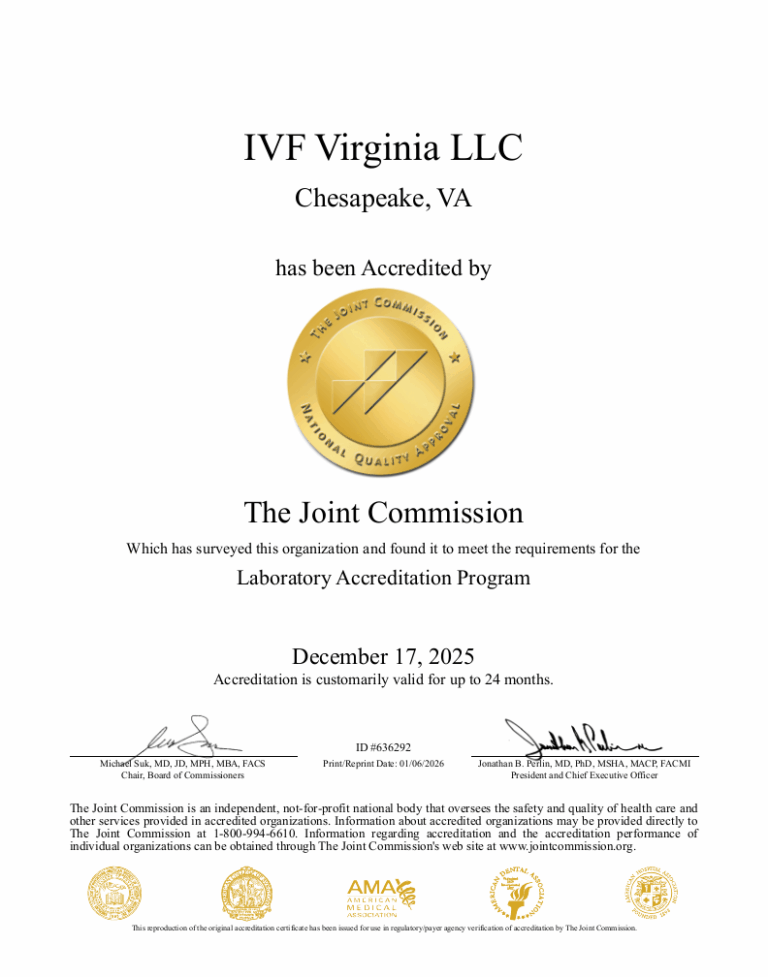
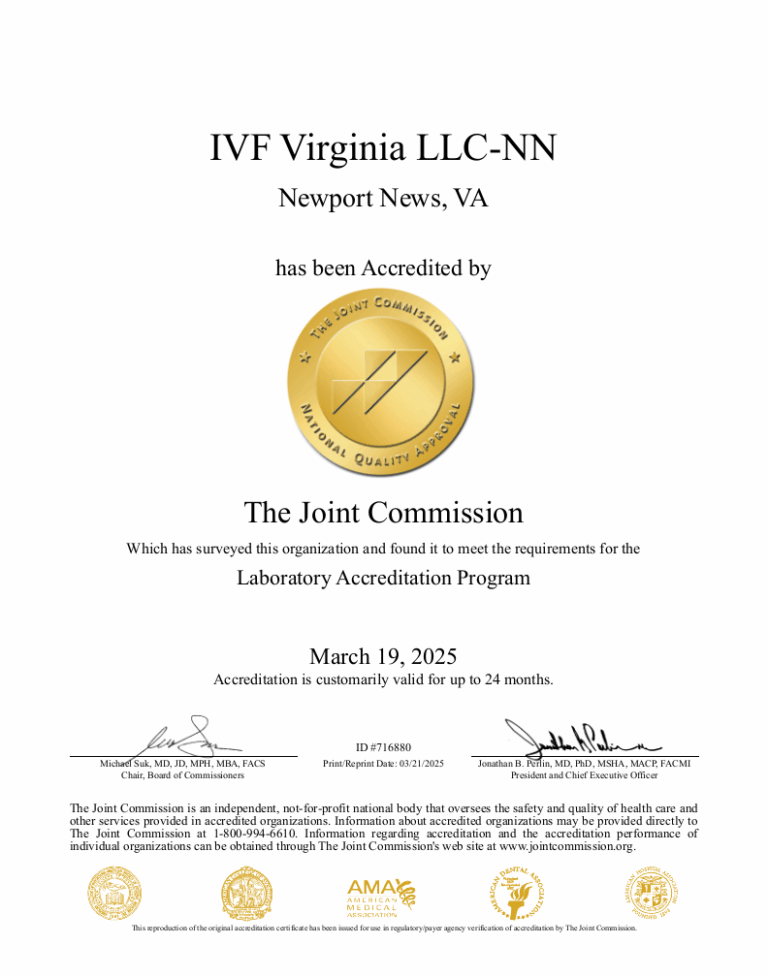
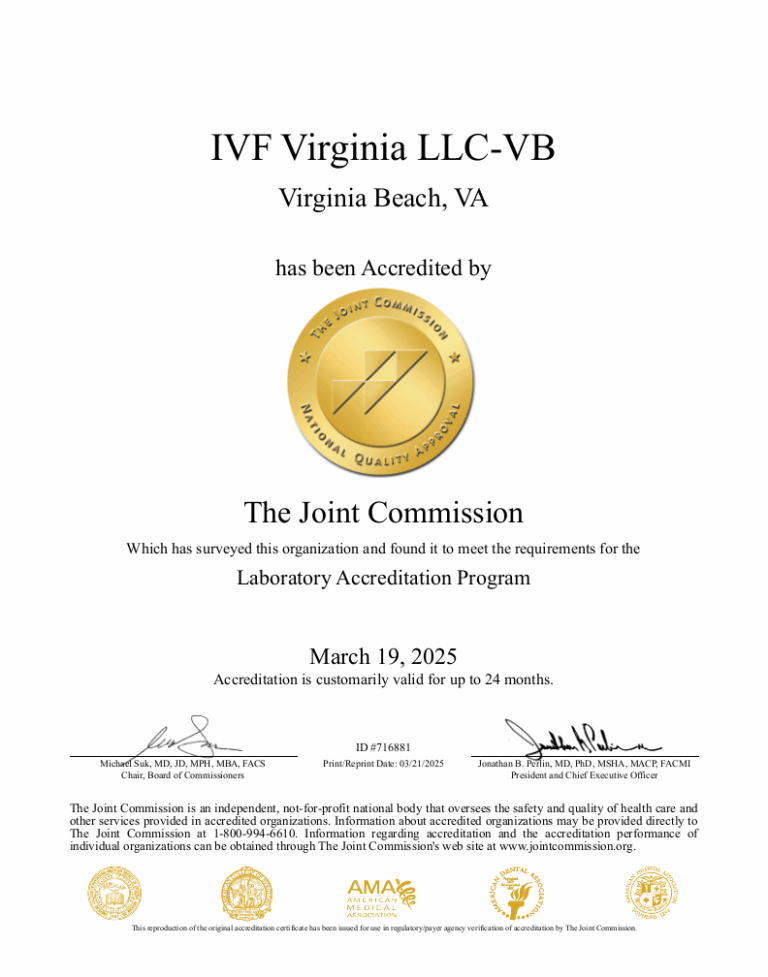
Our laboratory is accredited by The Joint Commission on Accreditation of Healthcare Organizations.
Yes to all four. Our laboratory operates with HEPA filtration, volatile organic compound control, positive pressure, and documented air quality monitoring.
Yes to both. Our incubators and cryostorage tanks are continuously monitored and fitted with external alarm systems that alert staff to any out-of-range condition.
Yes. Every critical step involving identification of your eggs, sperm or embryos is confirmed by two qualified witnesses before it proceeds.
Your fertility future starts with a conversation
Accreditation
Joint Commission on Accreditation of Healthcare Organizations

Procreate Fertility Center of Virginia’s laboratory is accredited by the Joint Commission on Accreditation of Healthcare Organizations and strives to maintain the highest level of quality in performance of our services to our patients.
Patients with complaints are advised that they have the right to contact our accrediting body to file a complaint:
Patients with complaints are advised that they have the right to contact our accrediting body to file a complaint:
One Renaissance Boulevard
Oakbrook Terrace, Illinois 60181
http://www.jointcommission.org
Oakbrook Terrace, Illinois 60181
http://www.jointcommission.org
630-792-5800
customerservice@jointcommission.org
customerservice@jointcommission.org